


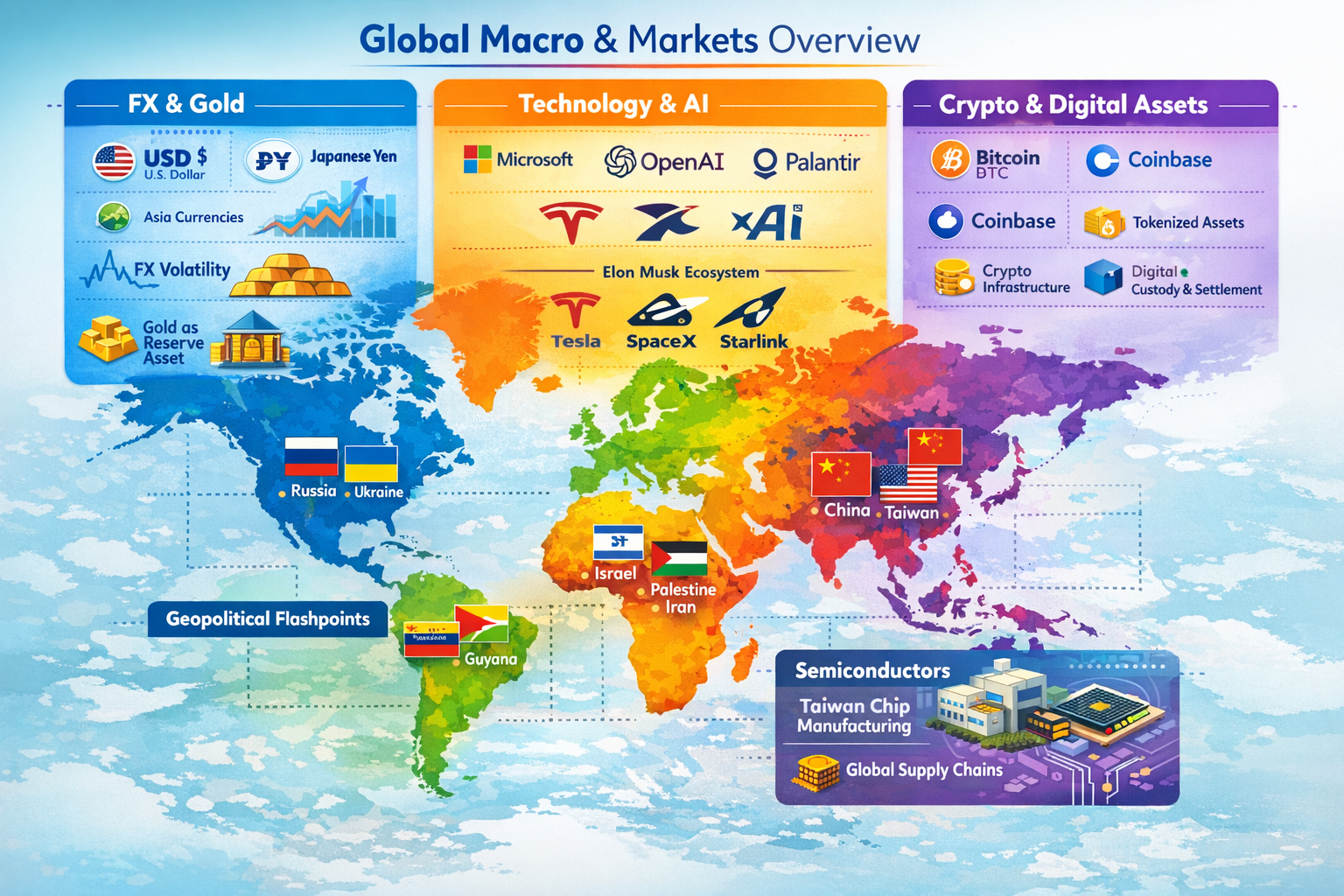
2026 Outlook: Markets Will Reward Control, Not Balance
Most outlooks going into 2026 are still framed around growth cycles, soft landings, or rate expectations. That framing is incomplete.
The defining feature of 2026 is not inflation, GDP, or policy rates. It is control control of supply, control of capital, and control of strategic infrastructure. Markets are already adjusting to this reality, and asset performance is beginning to reflect it.
Trade and Capital Flows Are Now Power-Driven
Countries are accepting higher costs and slower throughput to reduce dependence on single suppliers, currencies, and payment systems. Supply chains are being duplicated.
This has clear market consequences.
FX volatility rises because flows are influenced by policy decisions as much as economic data. Commodity pricing becomes less linear because supply is constrained by regulation, sanctions, and geopolitics rather than demand alone. Capital allocates unevenly, favouring entities that can operate across multiple jurisdictions without exposure to a single political bottleneck.
Semiconductors and Escalating Geopolitical Pressure
Geopolitical risk is no longer theoretical.
Active conflicts are already in place across multiple regions, and each new escalation increases systemic sensitivity elsewhere.
Within this environment, Taiwan remains the most critical strategic node in the global economy.
The risk is not limited to invasion scenarios. Export controls, regulatory pressure, sanctions enforcement, shipping constraints, and military signalling all restrict access to advanced semiconductors. These measures are cumulative.
As global conflict expands, pressure on this chokepoint intensifies.
Markets reflect this reality. Semiconductors continue to trade with a structural premium despite broader equity volatility. The U.S. strategy is containment through restriction rather than escalation. China’s strategy is endurance rather than urgency.
From an FX perspective, this keeps Asia-linked currencies volatile and risk premia persistent. This situation does not resolve quickly. It compounds.
AI: Capital Concentration, Not Innovation
By 2026, AI is no longer an innovation theme. It is an infrastructure allocation.
Spending shifts from experimentation to consolidation. Budgets concentrate around platforms embedded in enterprise and government systems. Optional tools are removed. Systems that influence decision-making remain.
Most AI labelled companies fail, not because AI demand weakens, but because capital concentrates around a small number of control layers. Distribution, data ownership, and compute access matter more than model quality.
This dynamic favours firms already embedded in operating systems, cloud infrastructure, and regulated workflows.
Microsoft’s positioning reflects this. Its investment structure and integration with OpenAI are not designed for rapid monetisation. They are designed to embed AI into enterprise defaults. The strategy is slow, durable, and difficult to reverse.
System Builders, Not Product Companies
The same logic applies to Elon Musk’s companies.
Viewed individually, Tesla, SpaceX, Starlink, and xAI appear unrelated. Viewed together, they form a vertically integrated system spanning energy, transport, communications, and data. The value is not in near-term cash flows. It is in cumulative system control.
Palantir fits the same category. Its platforms operate inside defence, intelligence, and large-scale enterprise environments where decision accountability matters. As AI deployment moves from pilot programs to operational use, embedded systems gain pricing power. Optional software does not.
2026 rewards companies that are difficult to remove.
Gold as a Credibility Asset
Gold’s behaviour has changed.
It is no longer primarily responding to inflation expectations or crisis events. It is responding to confidence in policy frameworks.
Central banks continue to accumulate gold as reserve diversification. Fiscal trajectories in developed markets remain stretched. Political cycles shorten. Monetary policy faces credibility constraints.
Gold does not require panic to perform. It requires sustained uncertainty around fiscal and monetary discipline.
Crypto and Market Infrastructure
Crypto enters a filtering phase in 2026.
Narratives lose relevance. Survivors are determined by supply discipline, settlement utility, governance, and regulatory compatibility. Most tokens fail. A limited number persist.
Tokenisation gains traction because it reduces settlement risk and operational friction. This aligns with institutional adoption, not retail speculation.
In this environment, infrastructure matters more than asset beta.
Coinbase benefits from regulatory consolidation. Custody, compliance, and transparency become prerequisites. Coinbase’s role shifts toward infrastructure provision rather than trading activity.
This is a market-structure exposure, not a directional crypto trade.
FX and the Dollar Regime
The U.S. dollar enters 2026 with a split profile.
Structurally weaker over time due to fiscal pressure and diversification efforts, yet still dominant during stress due to liquidity and capital-market depth.
For FX desks, this implies broad dollar softness interrupted by sharp risk-off rallies. Yield differentials continue to dominate in Japan unless policy normalisation accelerates meaningfully.
Policy timing remains difficult globally. Cutting too fast undermines credibility. Cutting too slowly risks employment and growth.
Bitcoin enters 2026 in a materially different position than it held in previous cycles.
The shift occurred in 2024–2025, when institutional approval moved from discussion to deployment. Spot ETF approval, regulated custody, and balance-sheet participation reframed Bitcoin from a speculative instrument into a recognised asset class.
In 2026, Bitcoin is no longer priced as an experiment. It is priced as a macro sensitive asset with defined allocation behaviour. Institutions do not treat it as a replacement for fiat or a pure risk asset. They treat it as a non-sovereign store of value with liquidity, portability, and settlement finality.
Conclusion
Our view is that 2026 marks a clear shift in how markets function as the global order continues to change under geopolitical pressure. Power dynamics now shape trade, capital flows, and asset performance more than traditional growth cycles or policy guidance.
Geopolitics is no longer a background risk; it is an active force restructuring supply chains, technology access, currency behaviour, and reserve preferences.
As this transition accelerates, markets increasingly reward assets and systems that are defensible, embedded, and institutionally accepted. Control of infrastructure, credibility, and enforcement matters more than speed or narrative appeal. Capital concentrates where political risk is managed rather than avoided, and where access cannot be easily disrupted.
In this environment, broad balance gives way to selective positioning. The winners are not defined by optimism or fear, but by their role within the evolving global system. Our outlook for 2026 reflects this reality: markets are adjusting to a world where geopolitical alignment, strategic control, and durability drive returns more than traditional macro assumptions.


