


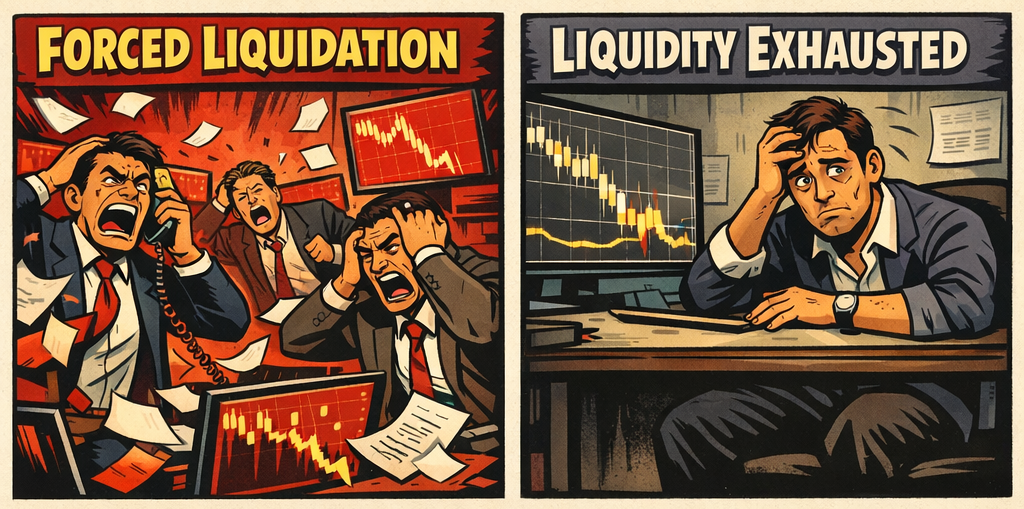
Gold hit $4,100 on March 23. That was the flush. Every overleveraged long, every panic seller, every institution raising cash to cover energy losses finally let go at that level. And from that low, gold has put in four straight sessions of gains including a 3.5% single-day rip on April 1, the strongest move in two months. We are now trading around $4,719. The upleg has started. And the war just heated up again.
Let me walk you through both.
THE QUICK RECAP
Gold came into this war at $5,296 on February 28, the day Operation Epic Fury launched and the US and Israel took out Supreme Leader Khamenei in the opening hours. It spiked to $5,423 on the safe-haven trade before immediately reversing as the real macro dynamic took over. Oil shock meant inflation. Inflation meant the Federal Reserve was not cutting. No cuts meant dollar strength. And dollar strength meant gold was dead weight sitting next to 4.8% Treasuries.
The selling was mechanical, not fundamental. Exchange traded funds bled billions. Central banks that had spent all of 2024 and 2025 accumulating gold flipped to sellers overnight to fund energy imports at $120 Brent crude. Gold had also rallied 60% the year prior, so every leveraged long was sitting on a profit stack with a perfect excuse to exit and they took it. By March 27 gold was down 13.6% on the month. Its worst performance against any conflict in 50 years. The January all-time high of $5,595 felt like a different world entirely.
LAST WEEK — WHERE IT GETS INTERESTING
March 23 is the date that matters. Gold briefly touched $4,100 intraday, just below the 200-day exponential moving average sitting at $4,200, and printed one of the most significant reversal candles of the year. Long bullish pin bar. Extended lower wick. Narrow body. Textbook exhaustion. The selling had simply run out of fuel.
From that low the structure began to change. The dollar started softening. The market began repricing the Federal Reserve narrative, not back to cuts immediately but the aggressive hike talk started losing steam. Positioning in the futures market was now clean. The crowded longs from January were gone. Short sellers were in control and that made them vulnerable.
Then April 1 happened. Gold moved 3.5% in a single session. Chicago Mercantile Exchange futures for April delivery hit $4,612. Spot gold pushed to $4,719. Four consecutive sessions of gains is not the kind of sequential structure you see during a dead cat bounce. It is the kind you see at the beginning of a trend change.
The key levels right now: $4,200 is the floor, the 200-day exponential moving average that held during the March 23 test. $4,600 is the first resistance, then $4,700, then $5,000 as the major ceiling. Getting through $4,800 with conviction opens the path back toward $5,400. Goldman Sachs reiterated that target on March 31 and they have not moved off it.
THE WAR IS NOT COOLING DOWN — READ THE GROUND, NOT THE HEADLINES
This is where most people are getting confused right now. Trump says the war ends in two to three weeks. Markets hear that and start pricing de-escalation. Gold softens on the peace narrative. But the ground and the headline are not telling the same story and one of them is wrong.
Day 33. Iran's Islamic Revolutionary Guard Corps says the Strait of Hormuz is fully under their control. Iran rejected the US 15-point peace plan outright. Foreign Minister Araghchi told Al Jazeera directly this week that no negotiations are ongoing whatsoever. Iran is also now conditioning any ceasefire on Lebanon being included in the deal, which immediately widens everything that needs to be resolved before anything stops. A Kuwaiti oil tanker was struck in Dubai port this week. Saudi Arabia intercepted eight ballistic missiles targeting Riyadh. Three Indonesian United Nations peacekeepers were killed in Lebanon. Pentagon chief Hegseth said the coming days would be decisive and refused to rule out ground forces when asked directly.
And now there is the Kharg Island conversation. Kharg Island processes roughly 90% of Iran's oil exports. If the US moves on Kharg, and the April 6 deadline being floated in markets is real, you are looking at a complete seizure of Iranian energy export capacity on top of an already closed Hormuz. That is not de-escalation. That is the war entering an entirely new phase. West Texas Intermediate crude is sitting at $103 with that risk premium fully baked in and it has not moved because the market understands what a Kharg operation actually means.
Trump's own officials privately admitted to CNN this week that they cannot guarantee the Strait reopens even as part of a deal. Spain, France, and Italy have all restricted US military operations and closed their airspace. The coalition is fragmenting. The timeline keeps getting pushed out. Four days became three weeks and three weeks became two more. Foreign policy analyst Trita Parsi of the Quincy Institute said it plainly: the United States is no longer in control of the pace of this war.
OUTLOOK AND PRICE FRAMEWORK
The March 23 intraday low of $4,100 is, in our assessment, a technically and structurally significant exhaustion point. The 200-day exponential moving average held on contact. The reversal candle that followed carried the characteristics of a genuine demand re-entry, extended lower wick, compressed body, elevated volume on the recovery. And the four consecutive sessions of appreciation that followed, including the 3.5% advance on April 1, are consistent with a trend transition rather than a technical bounce inside a continuing downtrend.
The forced liquidation cycle that defined March looks complete. Exchange traded fund outflows have stabilised. Futures positioning has been substantially cleaned out. The marginal seller, largely central banks monetising gold reserves to fund energy import costs, has reduced in size as energy markets begin adjusting to the new supply reality. What remains in the market is not distressed selling. It is deliberate repositioning.
On the geopolitical side our base assumption is that the conflict duration is being materially underestimated by consensus. The following developments, all reported and verifiable, form the basis of that view.
Iran formally rejected the US 15-point peace framework. Tehran has conditioned any ceasefire discussion on the resolution of the Lebanon theatre, a complication that extends the negotiation timeline considerably. Source: Al Jazeera, April 1, 2026
The Islamic Revolutionary Guard Corps maintains the Strait of Hormuz is under full operational control. The Corps stated the waterway was fully under its control and denied any ceasefire negotiations were taking place, directly contradicting the White House's public framing. Source: CNN, April 1, 2026
Trump's own officials privately acknowledge the Strait may not reopen even under a deal. CNN reported this week that the White House increasingly believes it cannot promise Hormuz reopens as a condition of any resolution, a significant admission that undermines the de-escalation narrative entirely. Source: CNN, March 31
Pentagon chief Hegseth described the coming days as decisive and refused to rule out ground forces. Made publicly on March 31, this statement signals the operation has not entered any kind of wind-down phase. Source: Al Jazeera, March 31, 2026aljazeera.com/news/liveblog/2026/3/31/iran-war-live-kuwaiti-oil-tanker-hit-in-dubai-port-3-un-peacekeepers-killed
A Kharg Island operation is being actively discussed in markets. Kharg processes approximately 90% of Iran's oil exports. Markets are pricing an April 6 deadline around this risk with West Texas Intermediate crude holding above $103 as a direct reflection of that premium. If realised this would represent an energy supply shock well beyond the Hormuz closure alone. Source: FX Leaders, April 1, 2026
Key NATO allies have restricted US military operations. Spain, France, and Italy have closed airspace and denied base access, a fracture in Western coalition cohesion that complicates any swift resolution. Source: Al Jazeera, April 1, 2026
The International Monetary Fund has formally warned of the conflict's global economic reach. Fund economists noted that all roads lead to higher prices and slower growth, with the Hormuz closure removing as much as 20 million barrels per day from global supply and low-income economies already facing food insecurity as a direct consequence. Source: CNN, March 30
Taken together these data points are not consistent with a conflict approaching resolution. The timeline has been extended three times now. Four days became three weeks and three weeks became two more. Trita Parsi of the Quincy Institute summarised it plainly: the United States is no longer in control of this war. Source: Al Jazeera, April 1,
Against that backdrop we identify the following price framework for the remainder of 2026.
Base case, Hormuz closure persists through the second quarter with no Kharg operation: As dollar strength moderates and the Federal Reserve navigates the tension between oil-driven inflation and deteriorating growth conditions, gold re-attracts institutional allocation. Price target of $5,400 to $5,800 by the third quarter of 2026, consistent with Goldman Sachs' maintained year-end target of $5,400 and directionally aligned with JPMorgan and Wells Fargo's $6,300 projection. Source: Finance Magnates, April 1, 2026
Escalation case, Kharg Island operation or material broadening of the conflict: A supply shock of this magnitude would compress the gold recovery timeline significantly. We would anticipate a rapid repricing of $300 to $600 per ounce in the sessions immediately following such a development, with price action driven by safe-haven demand, energy inflation repricing, and a short-covering cascade in Chicago Mercantile Exchange futures. This scenario is not in consensus and that is precisely why the asymmetry is attractive. Source: The Middle East Insider, March 25
De-escalation case, credible ceasefire and Hormuz reopens: An oil price collapse would temporarily remove the inflation premium from the gold narrative and create downward pressure toward the $4,000 to $4,200 structural support zone. We view this range, anchored by the 200-day exponential moving average and the 61.8% Fibonacci retracement of the October 2025 to January 2026 rally, as a medium-term accumulation zone rather than a breakdown level. The structural drivers of the multi-year bull market in gold have not changed. Source: The Middle East Insider, March 25, 2026
Key technical level to watch: $4,800. A sustained close above this level, which corresponds to the backside of the broken short-term trendline and the convergence of the 21-day exponential moving average, would technically confirm the resumption of the primary uptrend and open a clear path toward the $5,000 to $5,400 range.Source: StoneX, March 30
The repricing of gold through March was mechanical in origin. The conditions that drove the structural bull, central bank reserve diversification, de-dollarisation flows, and the erosion of confidence in traditional fiat instruments, remain fully intact. In our view the correction has widened the entry opportunity. It has not altered the thesis.
SOURCES
Al Jazeera, April 1, 2026 https://www.aljazeera.com/news/2026/4/1/iran-war-what-is-happening-on-day-33-of-us-israel-attacks
CNN, April 1, 2026 https://www.cnn.com/2026/04/01/world/live-news/iran-war-us-trump-oil
CNN, March 31, 2026 https://www.cnn.com/2026/03/31/world/live-news/iran-war-us-trump-oil
Al Jazeera, March 31, 2026 https://www.aljazeera.com/news/liveblog/2026/3/31/iran-war-live-kuwaiti-oil-tanker-hit-in-dubai-port-3-un-peacekeepers-killed
FX Leaders, April 1, 202 6https://www.fxleaders.com/news/2026/04/01/gold-price-forecast-will-trumps-3-week-offensive-deadline-ignite-a-4805-recovery-or-a-4368-crash/
Al Jazeera, April 1, 2026 https://www.aljazeera.com/news/2026/4/1/trump-tells-allies-get-your-own-oil-says-iran-war-could-end-in-2-3-weeks
CNN, March 30, 2026 https://www.cnn.com/2026/03/30/world/live-news/iran-war-us-israel-trump
Finance Magnates, April 1, 2026 https://www.financemagnates.com/trending/why-gold-is-going-up-goldman-gold-price-prediction-sees-5400-as-xau-rebounds/
Ad Hoc News, April 1, 2026 https://www.ad-hoc-news.de/boerse/news/ueberblick/spot-gold-rebounds-to-4-719-as-goldman-sachs-holds-5-400-year-end-target/69048853
The Middle East Insider, March 25, 202 6https://themiddleeastinsider.com/2026/03/25/gold-price-forecast-april-2026-crash-23-percent-what-comes-next/
StoneX, March 30, 2026 https://www.stonex.com/en/insights/gold-2026-outlook-what-s-in-store-for-xau-usd-in-q2-2026-03-30/


